
Verbs in Japanese
November 24, 2011 § Leave a comment
In Japanese, their are two particles used when a verb is in a sentence. を (wo) is used when directing an object, and に (ni) is used when the verb is associated with time. Ex #1. とうきょう に いきます (tokyo ni ikimasu) (I) Go to Tokyo Ex #2. にほんご を はなします (nihongo wo hanashimasu) (I) Speak Japanese The end of the verb ます(masu) is pronounced “mas”. This will be common for the other verb-endings. ます is the present/future-tense verb ending. The verb ending ました (mashita) is pronounced “mashta”. This is the past-tense verb ending. Ex #1. こうえん に あるきました (kouen ni arukimashita) (I) Walked to the park
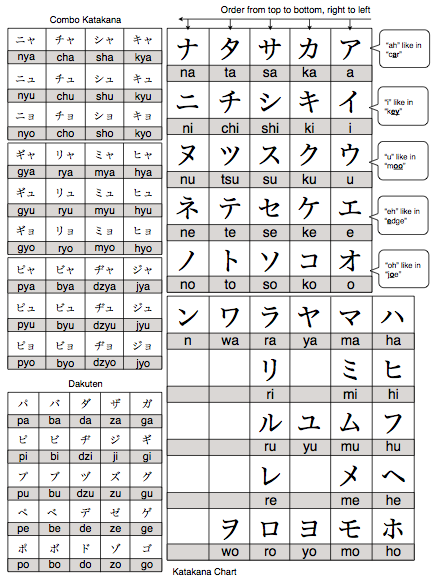
Katakana Alphabet
October 1, 2011 § Leave a comment
In my first post I discussed the different kinds of Japanese alphabets. Katakana is one of them. Katakana is an alphabet that is used to translate foreign words and phrases. Katakana is usually used in places like micdonalds or airports. The alphabet is very similer to the Hiragana alphabet with the same sounds. Just different kana, and ways to use it.
Name-Enders(What’s Mine)?
August 19, 2011 § Leave a comment

Who Are You?
In japanese culture, the japanese like to use adjectives when they describe their name. Here are the most common:
〜さん(san)
This is a standard name-ender.
〜くん(kun)
This is for younger boys/adults. If you are unfamiliar with someone, 〜さん(san) is the way to go.
〜ちゃん(chan)
This is used for girls or younger children, like a younger sibling. The person’s name can be shorten when used (ed-chan).
〜せんせい(sensei)
This is used for teachers. This also can be used by doctors (Medic or PHD).
〜せんぱい(senpai) This is used for higher-rank students. Like someone higher-grade or more skilled.
How To Say No!!!
August 14, 2011 § 2 Comments

In my latest blog, I disscused how to say “YES” in Japanese. This time it is “NO”. No in japanese is IIE (いいえ). DESU (です) means “it is”. JYAARIMASEN (じゃありません) means “it is not”. Lets use it with a japanese word! SHINBUN (しんぶん) is Newspaper in japanese. SHINBUNDESUKA (しんぶんですか) means Newspaper, it is? IIESHINBUNJYAARIMASEN (いいえしんぶんじゃありません) means “No, Newspaper it is not” or “No, it is not a Newspaper”.
Yes and Ka (What?!?)
August 9, 2011 § Leave a comment

Last time we talked about “desu”. Which pretty much means “it is”. When “ka” is used at the end of a sentence it turns it into a question. Like a question mark. Lets use it with a japanese word. “ichigo” means stawberry. So, ichigodesuka (いちごですか) means “strawberry it is?”. Yes in japanese is “hai”. When hai is used in the begining of a sentence it turns into a response. So haiichigodesu means “yes strawberry it is”.
DESU/です
August 9, 2011 § Leave a comment

What is です(desu-{pronounced}dess)? Its a way of identifying something in japanese. Its like saying “it is”, instead of saying “that is”. Lets use it with a japanese word. saru/さる means monkey. So if you wanted to say “that is a monkey” all you need to do is say “sarudesu (さる です)”. That easy.
Combo Hiragana
August 2, 2011 § Leave a comment
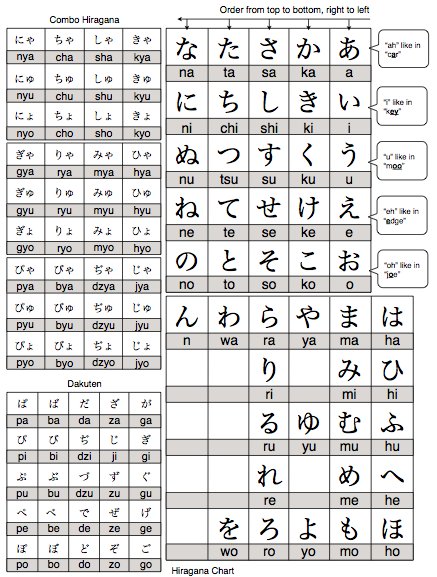
Combo Hiragana are all “i” hiragana from the ka, sa, ta, na, ha, ma, ga, da(not shown), ra, za, ba, and pa collum. They are then combined with all the “ya” hiragana, thats were the “combo” part comes in.

Dakuten (What’s That?)
July 14, 2011 § Leave a comment

Dakuten is like the main hiragana alphabet with a quotation(“) mark by it.
Well more like the Ka(G), Sa(V), Ta(D), and Ha(Ba, Pa) Hiragana.
Here is the catch, the Ha Hiragana has not only a
quotation mark, but a degree(°) mark as well.
Hiragana Characters (There’s More Than One?)
July 9, 2011 § Leave a comment
The picture on the bottom shows all the Hiragana Characters. What is Hiragana? It’s like the (english) alphabet, with more letters. I’ve reconized thirty (a-ho), and I’am memorizing the rest. Q: What was your reaction to the chart?
Hiragana Chart
Hiragana Pattern (To Much Thinking!?)
June 27, 2011 § Leave a comment
 Hiragana is known as “hard kanji’
Pronounciation of it is quiet easy :
(In Romaji)
a – ah – car
i – eee – key
u – ooo – moo
e – eh – edge
o – oh – joe


